PXS Electronics Work
As we develop new state-of-the-art amplifier technology for sub-GHz bands, we have needed to develop supporting infrastructure for the auxillary components that make up the rest of our read out chain. Two of the standout infrastructure pieces has been designing room-temperature analog circuitry that controls a cryogenic multi-pole switch, and designing superconducting lumped-element diplexers. This work is complimentary to the effort to develop high quality coaxial cable - see more on that work in PXS Coax Development.
Research Components
RF Switch Analog Control Circuits
Like many quantum devices research groups, we utilize multi-pole switches to be able to increase the testing volume per channel in our cryostat. While there are commercially available control systems available, many of our peer groups found working with them difficult. Further, prior experiments with digital control of switches have introduce high-frequency noise that can be detrimental to performance. By creating a fully-integrated homemade system, we could create a design that relied only on analog circuitry for the control signals and design software that was intuitive for our workflow.
Hardware
The basic design problem is to design a circuit that can generate an energy packet that accomplishes reliable switching while minimizing the heat dissipated onto the cold stage. One of the primary challenges is managing the dynamic range of the load resistance, as the high RRR of the copper used in the RF switch makes the load resistance vary by mulitple orders of magnitude between room temperature and cryogenic operation. We could resolve this problem with basic electronics components by using multiple voltage regulators to vary the reference voltage used for a push-pull transistor configuration. Fundamentally, our design gives us a hardware-configured pseduo-constant current source that we can fine-tune with separate potentiometers for pulse width and supplied current.
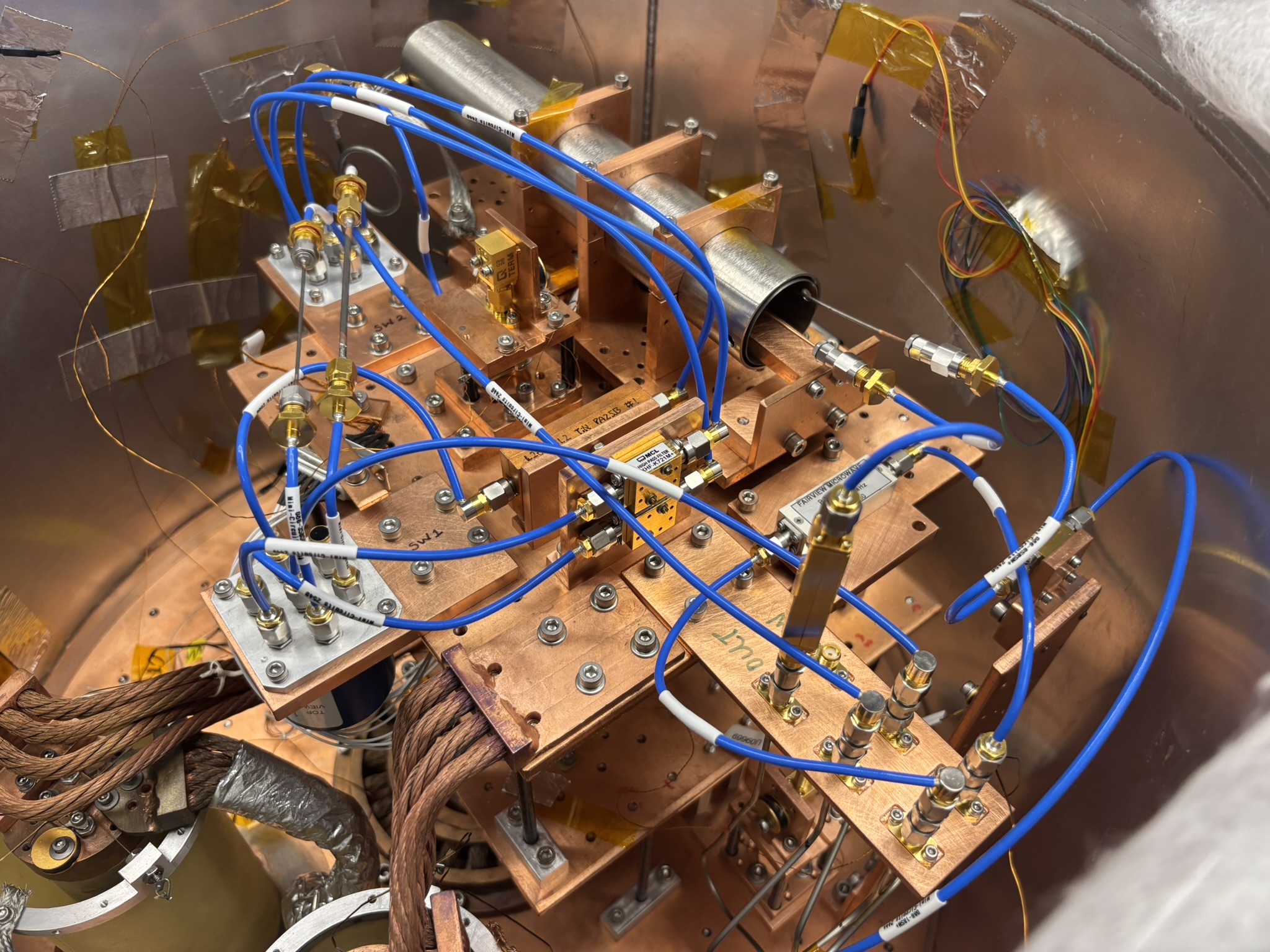
The RF switch itself uses inductor coils to acutate each pole. By nature, this is a bi-polar design - which means we can reverse the action (open vs close) by reversing the direction of the current through the same lines. To allow our control hardware to mirror this property, we control our signal flow with a set of USB-controlled relays. By daisy-chaining the relays we can use N relays to access both polarity states for N wires. The relay switch only provides electrical connectivity, and we implement a time delay to ensure that any residual contact bounce in the relay decays before our signal passes through. This design allows us to control a cryogenic switch with a single current supply board, and single relay channel board. The bi-polar design reduces the number of wires runing cryogenically, which improves the thermal performance of the cryostat. We measure only single digit milli-joules of heating from our circuitry, which is a transient load. Practically, we are able to comfortably integrate multiple switches and operate below 300 mK and able to switch cryogenic loads at 10 mK inside our Dilution Refridgerator.
Software
Because we establish our control signal in hardware, once a board is calibrated, it can be controlled with a single usb interface. To accomplish our bi-polar design, we need to control the state of all relays for each intended cryogenic switch operation. The board we selected allows all the switches to be configured by treating them as an 8-digit binary number, and can be expressed equivalently in hexidecimal. This allows our python function to generate the set of configuration commands with a simple bitshift operation. For quality of life we parse user arguments so they can focus on what should happen cryogenically. If they want to open channel 1 cryogenically the syntax is: python relay.py -channel 1 -action open. The script with configure the relays, trigger the pulse generation, and then disconnect the relays. We also have the ability to initialize the switch, because the switch itself does not have active read out and needs to be put into a known state. Our python script writes the last intended state of the cryogenic switch to our database for practical tracking as well.
Diplexers
Superconducting diplexers are a critical element in testing Kinetic Inductance Traveling Wave Parametric Amplifiers (KI-TWPAs) because of multi-tone output of KI-TWPAS. KI-TWPAs fundamentally produce gain through a conservation of momentum process where momentum of cooper pairs from a strong driving pump tone is divided into two complimentary tones called the signal and the idler bands. In the context of signal processing, this means the output of the amplifier has three output tones that need to be routed separately to avoid damaging downstream microwave components that may not have the same bandwidth or power handling properties as the KI-TWPA.
A diplexer is a type of passive filter where singly-terminated low and high pass filters are designed in a complimentary fashion such that a common input port is presented a continuous frequency output and can efficiently deposit power into two separate branches. By chaining these filters together, a single filter can take the output of the KI-TWPA and route the signal, pump, and idler tones into three physically separated branches. Commerical options are available, but typically use normal metal conductors, which can create thermal noise sources that could raise the measured noise of a quantum-limited amplifier. Our filters are designed using the same material fabrication stack as the amplifier so that future designs can create monolithic pieces that combine the filter and amplifier to reduce loss between elements and promote high-density assemblies for scaling quantum computers.
To design these filters, we use a stack of python scripts, LT Spice simulations, and Sonnet EM simulations. Sonnet supports macro utilities, so to accelerate the design process I created a macro that generates the target design components based on the prototype circuits in Matthaei, Young, and Jones, submits the initial components to Sonnet and conducts a steepest descent optimization to create the constituent components. Stay tuned for an update on the real world performance of our filter designs!
Related Work
This development supports the broader Princeton Axion Search (PXS) experiment and works in conjunction with other PXS systems including cryogenics, software development, and KI-TWPA amplifiers.