PXS Cryogenic Requirements
The Princeton Axion Search is a cavity Haloscope-style experiment, which requires cryogenic solutions to cool a superconducting magnet storing 6 mega-joules of energy, while simultaneously bringing the cavity detector and readout electronics to 40 milli-Kelvin (40 thousandths of a degree above absolute zero). Similar systems that cool large magnets, like MRI machiens, cool the magnet down by containing the system in a liquid Helium bath. These liquid helium baths are expensive and require sophisticated pressure vessels to handle the forces in case a magnet disruption rapidly boils the liquid Helium. As an academic research group, these requirements for liquid Helium designs would make the experiment prohibitively expensive. We are designing the experiment to be cooled entirely through conduction paths to pulse tube cryocoolers.
One of the challenging design problems for the magnet was handling the heating from the current leads while charging the magnet. To minimize the heating from the charging power running through the leads, we have to use an excellent conductor like copper: however, this creates a strong thermal link between two temperature stages which heats the colder stage. Our design problem was to create a solution to charge the magnet at 500 Amps and connected the 300 Kelvin and 40 Kelvin temperature stages.
Our design challenge to accelerate the sensitive readout electronics development was to create a cryostat that re-used Helium Adsorption fridges, which are capable of bringing a small test bed to 270 milli-Kelvin, to complement our Dilution Refridgerator work. The custom cryostat was a ground-up development to instrument the cryostat, design the room temperature breakout, and create the necessary software.
Each of these systems requires hardware and software design that ensures high-reliabilty, minimizes cost, and meets the research-grade performance.
Sub-system Research Components
High-Current Leads
To meet the design requirements of our superconducting magnet, we designed a system that enables us to connect our power supply to a standard vaccuum interface and creates a heatload within the capability of a mechanical pulse tube at each temperature exchange. The coldest temperature stage is able to leverage commercially available high-temperature superconducting current leads, but the link from room temperature to 40 Kelvin required innovation. We were able to design a system that balanced the joule-heating of the material against the thermal diffusivity to minimize the heat flux. By optimizing the interfaces we have been able to run over 500 Amps to 4 Kelvin for over 10 hours without raising the temperature above 5 Kelvin.
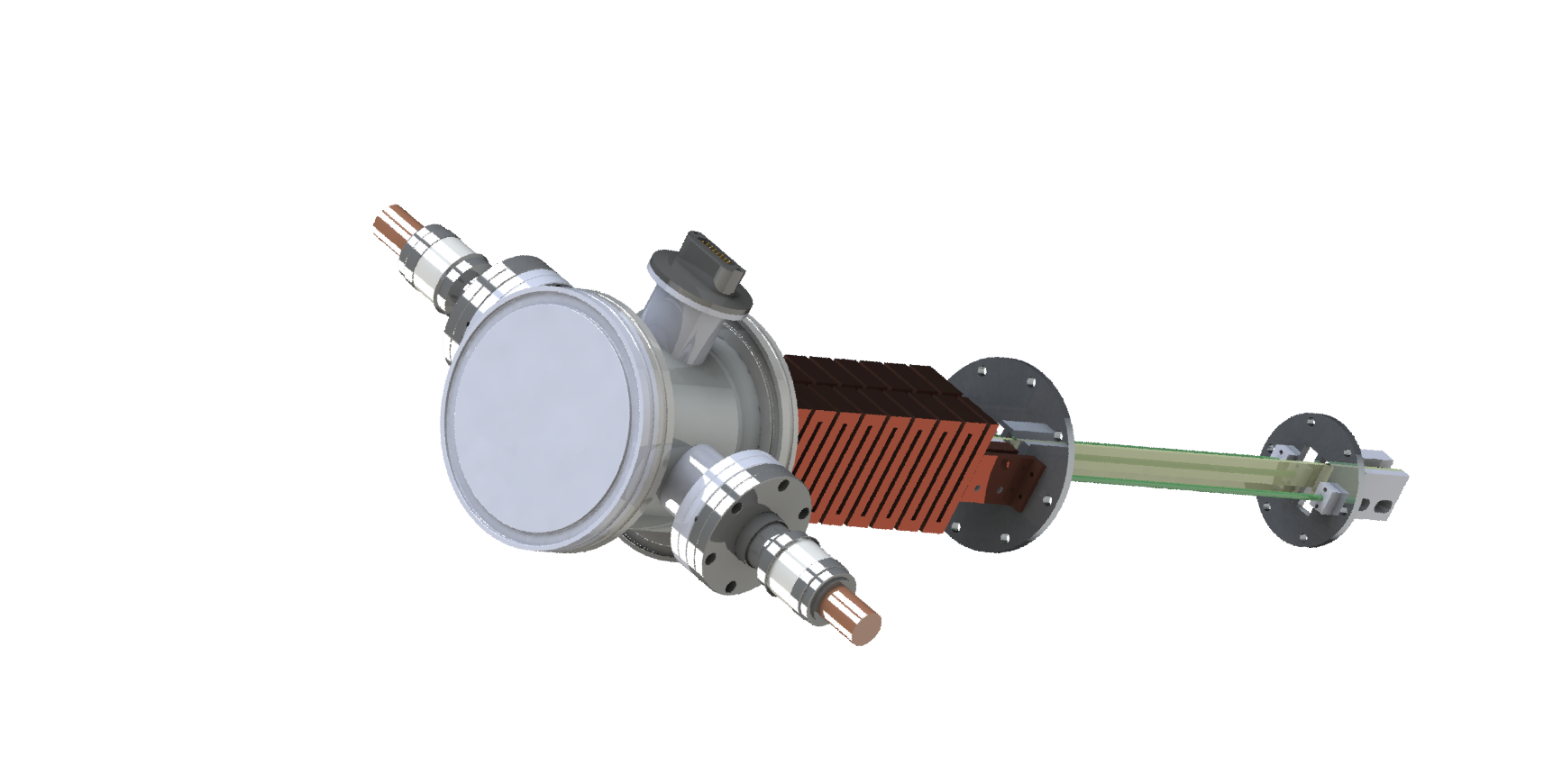 An early Solidworks render of the current lead design - which we call the ‘snake’
Rapid Prototype Cryostat
The development of the RF chain requires the ability to balance individual device tests with large-volume, short-turnaround, screening and full-chain debugging. By re-using Helium-4 and Helium-3 adsorption pots from a decommissioned cosmology experiment, we were able to create an inexpensive cryostat that can cycle from room temperature to 300 milli-Kelvin in 3 days. A major part of this rapid cooldown was our development of graphite heat switches - more detail is available under publications. By designing robust control software to safely automate parts of the experiment, see more in PXS Software Development, we are able to ensure that maximize our experimental uptime.
We have used this cryostat to refine our coaxial cable development process, develop our noise temperature measurement procedure, and screen numerous components for our full-scale system architecture. We have been able to achieve this testing scale by developing our own analog control circuits, see PXS Electronics, and complimentary software to integrate cryogenically-rated multi-pole switches without introducing and digital noise sources.
Sub-Kelvin Work
Precise noise temperature measurements are a critical output for our research group. We designed and commissioned a homemade variable temperature stage to be able to do Y-factor style noise measurements on both commercially available low-noise amplifiers, and the Kinetic Inductance Traveling Wave Parametric Amplifiers. By creating a solution in house, we were able substantially reduce the cost, and have greater control on trade-off between cooldown time and conductance to the reference stage.
Related Publications
- Passive pyrolytic graphite heat switch for sub-Kelvin coolers - Published in Cryogenics (2025)
Related Projects
This work supports the broader Princeton Axion Search (PXS) experiment, which searches for dark matter particle candidates in the axion mass range corresponding to the transitional region between lumped-element and cavity haloscope search techniques.