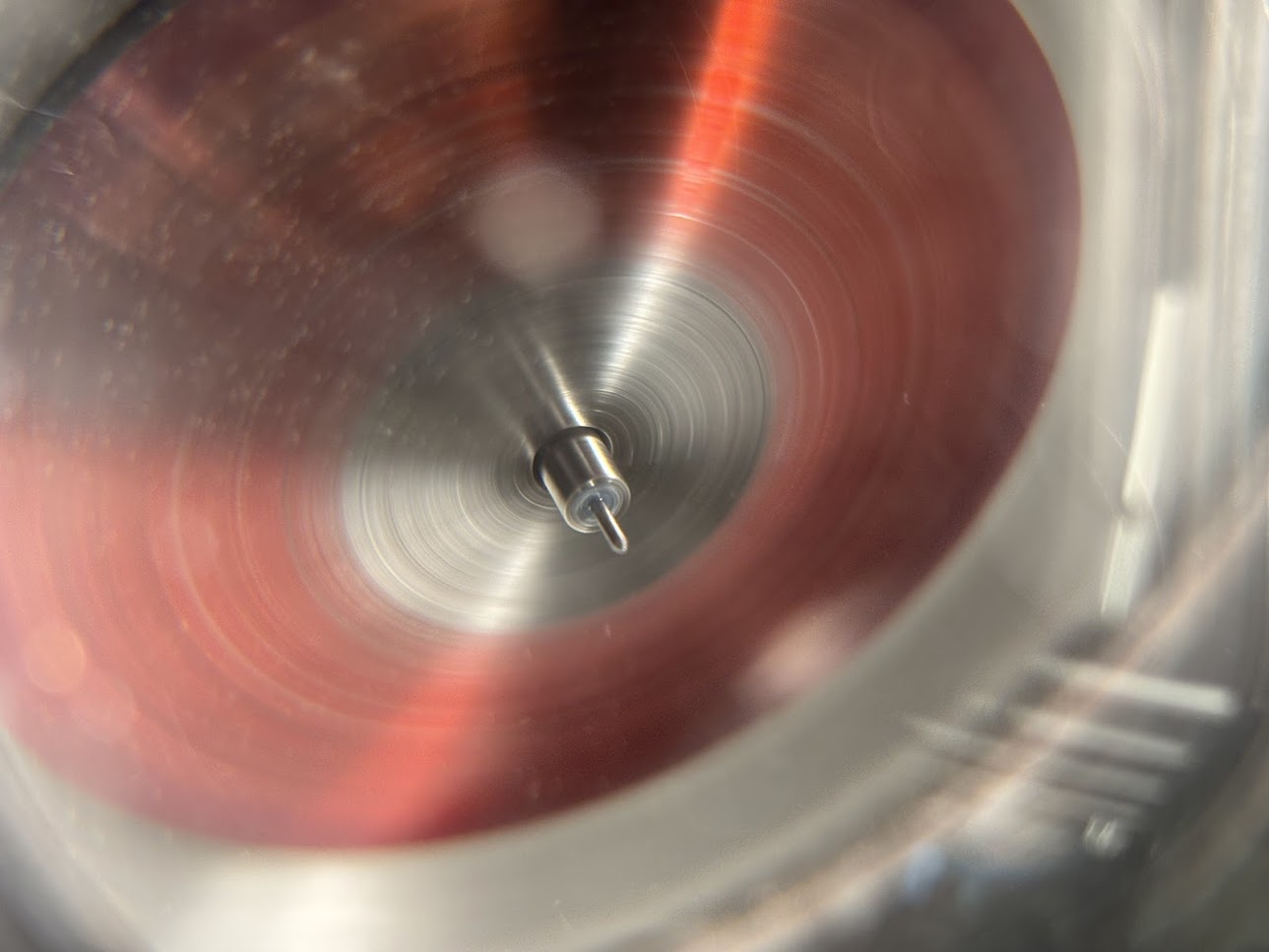
Coaxial Cable and PXS Readout
High-quality cryogenic coaxial cable is critical to sensitive microwave exferiments. While the expanding market in support of quantum computing has introduced numerous commericial solutions for bulk and/or high-density cable, these offerings remain expensive and require a-priori knowledge of the system design. By developing laboratory methods to fabricate our own cable I was able to reduce lead times and cost, achieve greater freedom in our RF system design, and provide bespoke-level focus that has resulted in leading systematic performance.
Our requirements
In order to develop a microwave readout testbed, we had to develop techniques that could address the wide range of challenges that face cryogenic microwave electronics. We need to manage thermal isolation between temperature stages by using weak thermal conductors. We can then maximize the utility-per-channel by creating a homemade solution to drive cryogenically-rated multipole switches at our base temperature; see PXS Microwave Electronics. This design reduces the number of permanent cables we need to run between temperature stages, which further optimizes our thermal budget within the cryostat. At our most sensitive stages, we can accomplish near-complete thermal isolation by leveraging the lack of thermal conductivity from superconducting materials.
Making superconducting coaxial cable is challenging because the Niobium Titanium material is more difficult to machine, the material does not natively adhere to solder, and crimped connections do not meet our microwave performance standards. I was able to achieve reliable ways to make soldered superconducting cables by refining my machining skills and process, and expanding upon copper-plating techniques that were found in relevant literature. Our primary system requirement is to have featureless transmission and to reduce reflections as much as possible. We observed a significant reduction in reflections from the cable by using a soldered connector rather than a crimped connection, and were able to match or exceed the transmission and reflection characterisitics of commerically available product used in other labs.
Developed Materials
The project involved developing laboratory methods to fabricate coaxial cable with:
- Stainless Steel: Workhorse material for weak thermal conduction from warm temperature stages
- Copper: Low-loss material with significant lower cost than NbTi for isothermal applications. Stability improvement over hand-formable.
- Superconducting Niobium-Titanium: Superconducting material provides thermal isolation for the most sensitive components
Primary Skills
- Bulk machining conducted on hand-controlled machine shop lathe with ten-thousandth DRO
- Soldered connections for stainless steel with etching flux and high silver content solder
- Improved copper-plating technique for Niobium-Titanium cables, allowing for soldered connections
- Sourced non-magnetic connectors and established high-yield soldering process
Performance Achievements
To date, some of the notable achievements of the cables have been:
- Improved bandwidth and gain for low frequency Kientic Inductance Traveling Wave Parametric Amplifier
- Input reflections (S11) measures below -30dB within the frequency range of SMA connectors
- Consistent performance through 10+ cooldowns, and liquid nitrogen dunk tests
- Reduced impedance mismatch on cryogenic HEMTs, constraining noise temperature measurements uncertainties to 10s of milli-Kelvin
- Fabrication yield above 90%
Utility for PXS
This work has enabled the Princeton Axion Search to achieve state of the art gain for sub-GHz KI-TWPAs, tightly contrain noise temperature measurements on commerically available amplifiers, and rapidly adapt our RF testbed to incorporate new devices. We expect to publish a brief note on our process soon, so check back!