Project Summary
This research project investigated whether imparting Orbital Angular Momentum (OAM) onto Gaussian mode laser beams improves their intensity stability when propagating through atmospheric turbulence. The work was conducted in a near-maritime environment, requiring the construction of a long-range optical link.
Research Objectives
The primary goal was to determine if OAM-carrying beams exhibit improved resistance to scintillation effects compared to standard Gaussian beams when propagating through turbulent atmospheric conditions.
Experimental Setup
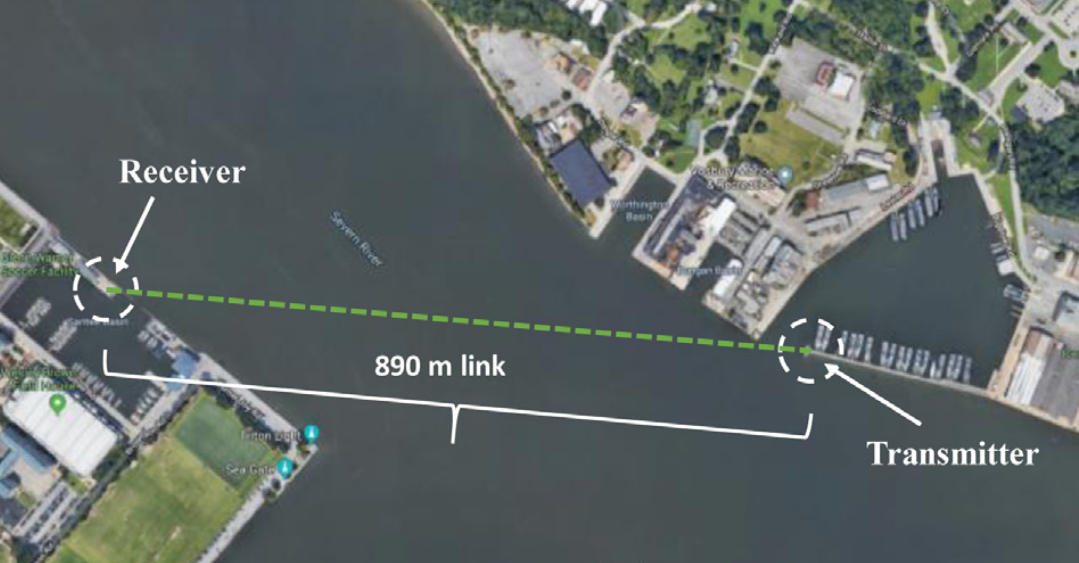
The experiment required building an optical link that was co-aligned to an infrared source for 890 meters across the Severn River. This challenging setup involved:
- Precise optical alignment over long distances
- Atmospheric turbulence characterization
- Intensity stability measurements
- Comparison between OAM and Gaussian beam modes
Key Findings
Demonstrated preliminary evidence that imparting Orbital Angular Momentum onto Gaussian mode laser beams weakly improves their intensity stability in atmospheric turbulence. This work provided valuable insights into the behavior of structured light in real-world atmospheric conditions.
Impact
This research was published in Optics Communications and represents an important contribution to understanding how structured light propagates through turbulent media. Conducting this work was an invaluable experience in learning to conduct publishable research.
Related Publications
- Scintillation of laser beams carrying orbital angular momentum propagating in a near-maritime environment - Published in Optics Communications (2020)