Project Summary
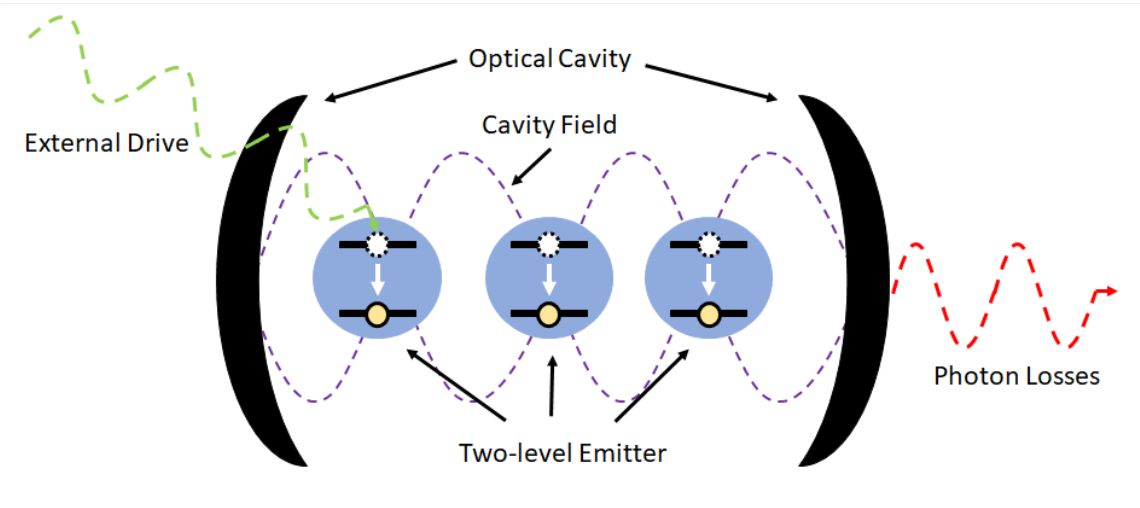
Senior thesis work in extracting coupling parameters for demonstrated superradiance from strain-tuned quantum dots in a Naval Research Labs experiment. For this work, the entire simulation was written in MATLAB for Hilbert spaces that represent distinguishable emitters and represented by total angular momentum. Computations were ran primarily locally.
Objectives
The simulation work focused on:
- Creating a first-principles models to re-create experimental results from NRL collaborators
- Writing a master equation suite to develop simulation of a quantum system connected to an adiabatic bath
- Developed wrappers to scale coupling operators to arbitrary hilbert space
- Evaluated Superradiant behavior based on second-order photon correlation
- Developed mechanisms to evaluate effects of coherent and incoherent driving fields
Featured plots
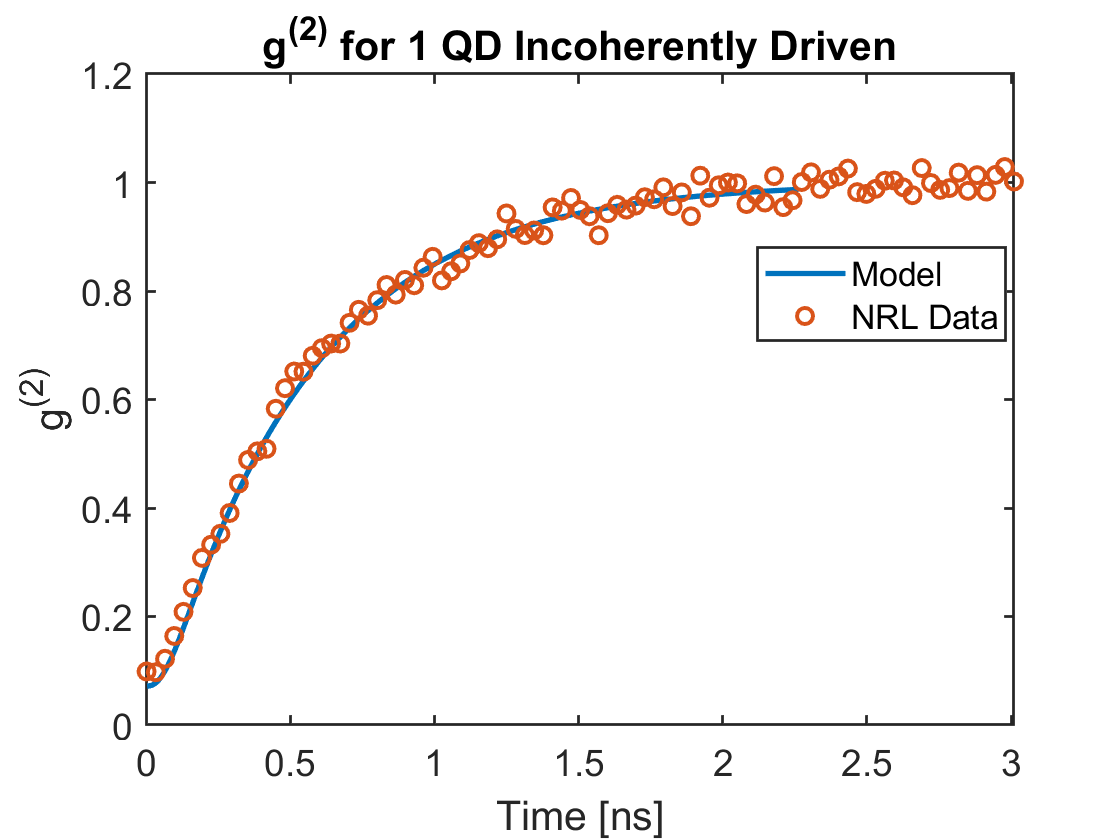
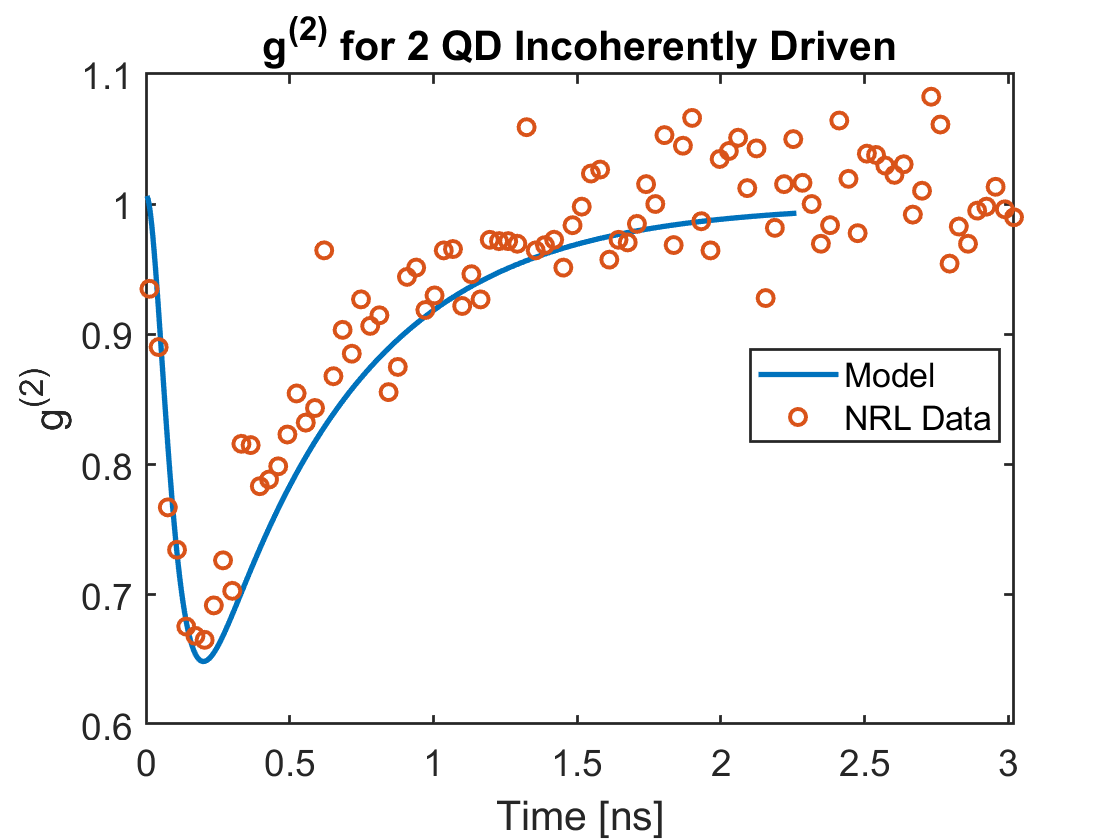
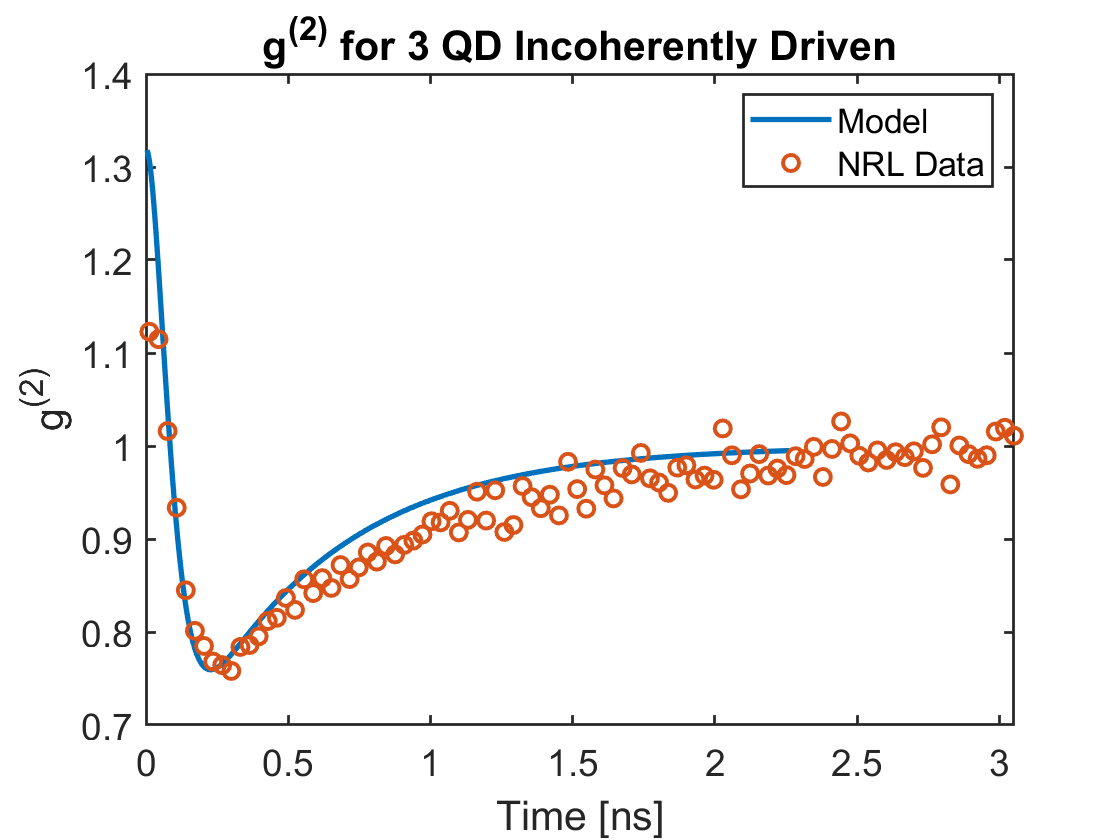
Ultimately the master-equation model was able to match the experimental data taken by the Naval Research Lab using only 4 free parameters.
Single emitter
The characteristic behavior is the immediate suppression in the photon-correlation
Multiple Emitters
With multiple emitters coupled to the cavity mode, the superradiant effect can be see via an immediate enhancement in the photon correlation number; followed by an immediate suppression.
Applications
This work created a custom, modular framework to analyze open quantum systems that could be used to simulate behaviors in my Rydberg research. My suite was in agreement with Julia.