Motivation
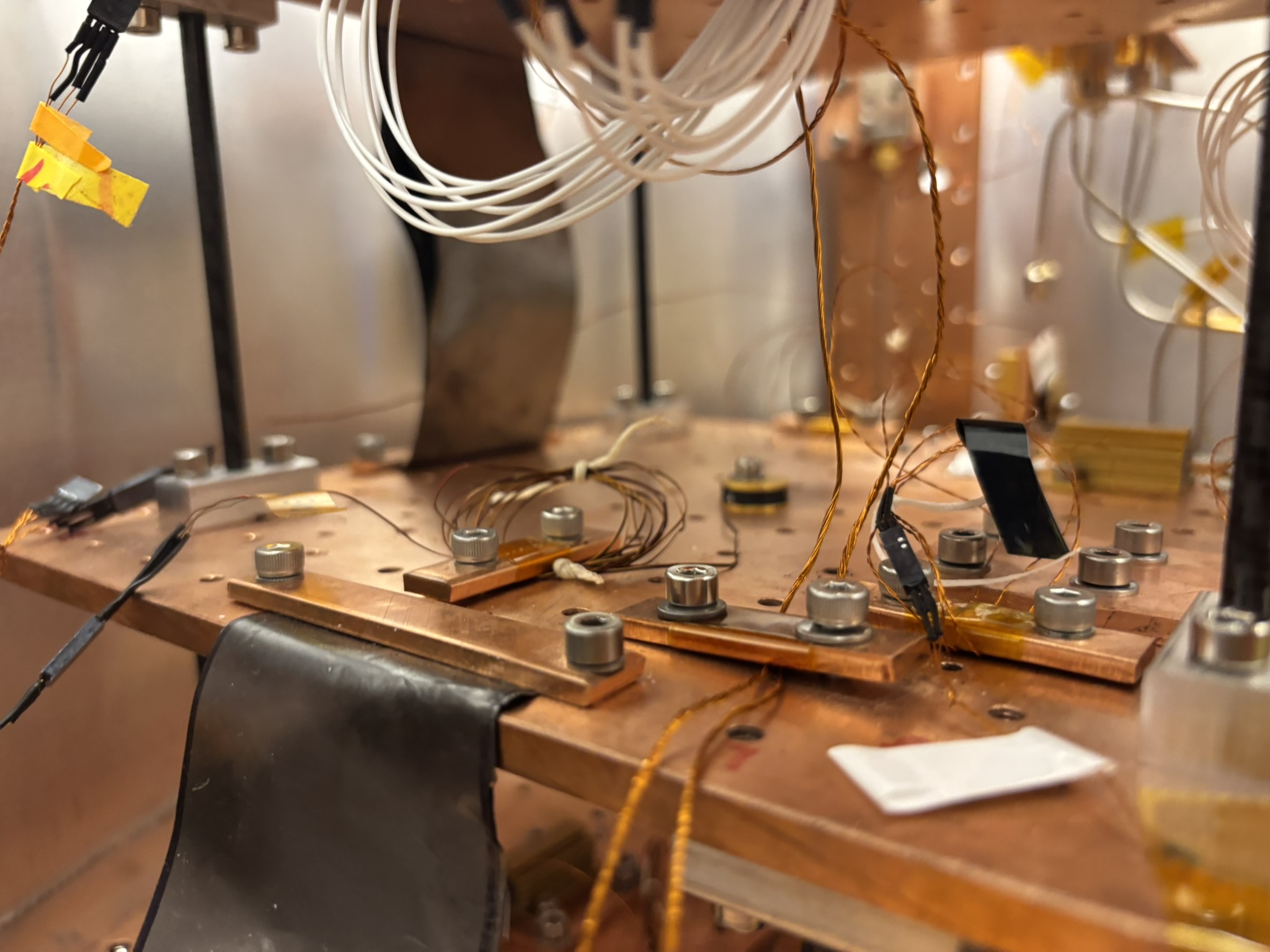
Cryogenic systems have the contradictory requirement of needing high thermal conductivity during the bulk cooldown period, and maximized thermal isolation at the base temperature operation. Heat switches provide a mechanism to change the thermal conductivity between two stages. A typical design is to use a gas-gap heat switch which uses a heater to expel Helium gas as a conduction mechanism between the two sides of the switch. These active switches can be costly and require additional DC wiring instrumentation in the cryostat. For large thermal masses in bulk cooldown, this can be an excessive effort to accelerate the cooldown process. However, pyrolytic graphite sheet demonstrates passive heat switch capabilities as the phonons freeze out and create minimal loading at base temperature. By analyzing the cryogenic performance of a custom-designed graphite heat switch, we were able to implement heat switches that sped up our bulk cooldown from ~4 days to ~2 days for less than 10% the cost of a gas-gap heat switch and without additional wiring instrumentation.
Abstract
We describe a passive heat switch based on a commercial pyrolytic graphite sheet. Measurements of the thermal conductivity of the graphite are presented, confirming a large difference between room temperature and ≈4 K. The implementation of a graphite heat switch in a cryostat operating a 3He/4He sorption refrigerator is demonstrated.
Achievements
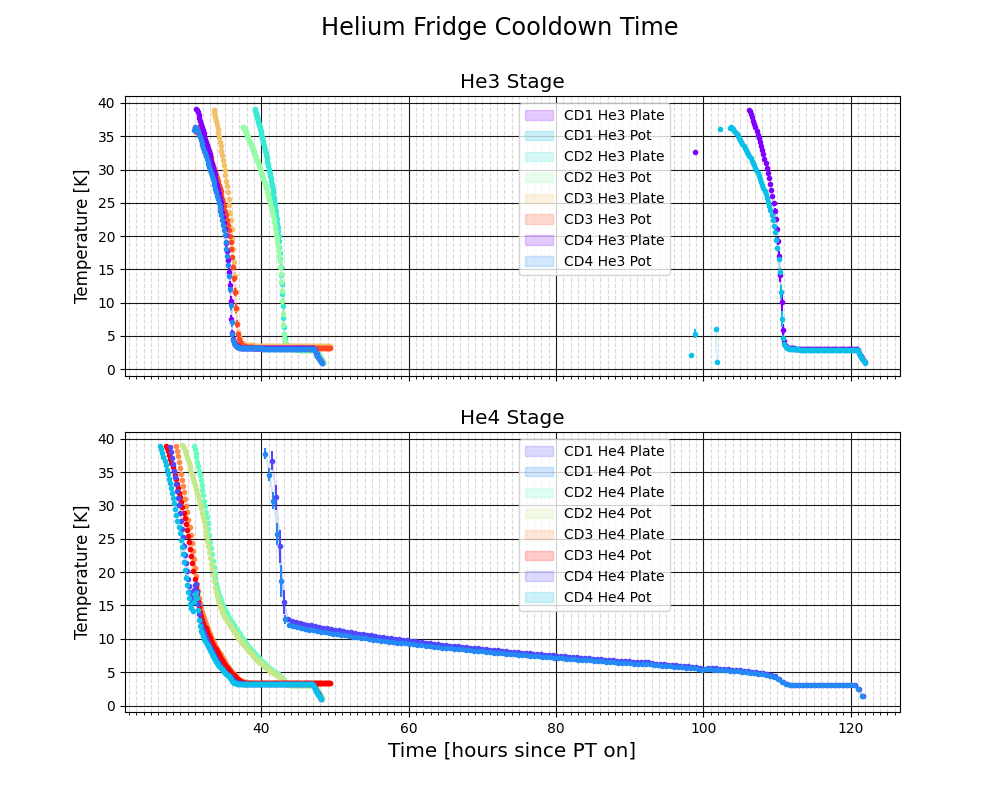
- Improved the cooldown time for the 3He stage by 50% with inexpensive graphite sheet
- Demonstrated the ‘off’ state of the switch applied only microwatts of heat load
- Proved durability through 10+ room temperature-cryogenic cycles
- Able to reduce the number of expensive gas-gap heat switches needed to conduct experiment
Cooldown Speed Up
By plotting the temperature of each stage against the hours since the pulse tube turned on, the graphite heat switches show multi-day speed ups for the Helium 3 stage cooldown. Which has enabled the cryostat to rapidly prototype RF components.
Links
Related Projects
This publication is based on research conducted in PXS Cryogenics.